Architecture overview
For enterprise and solution architects: the whole picture in one page. Each section links to the detail an engineer needs, so you can stop reading at the level you need.
The picture
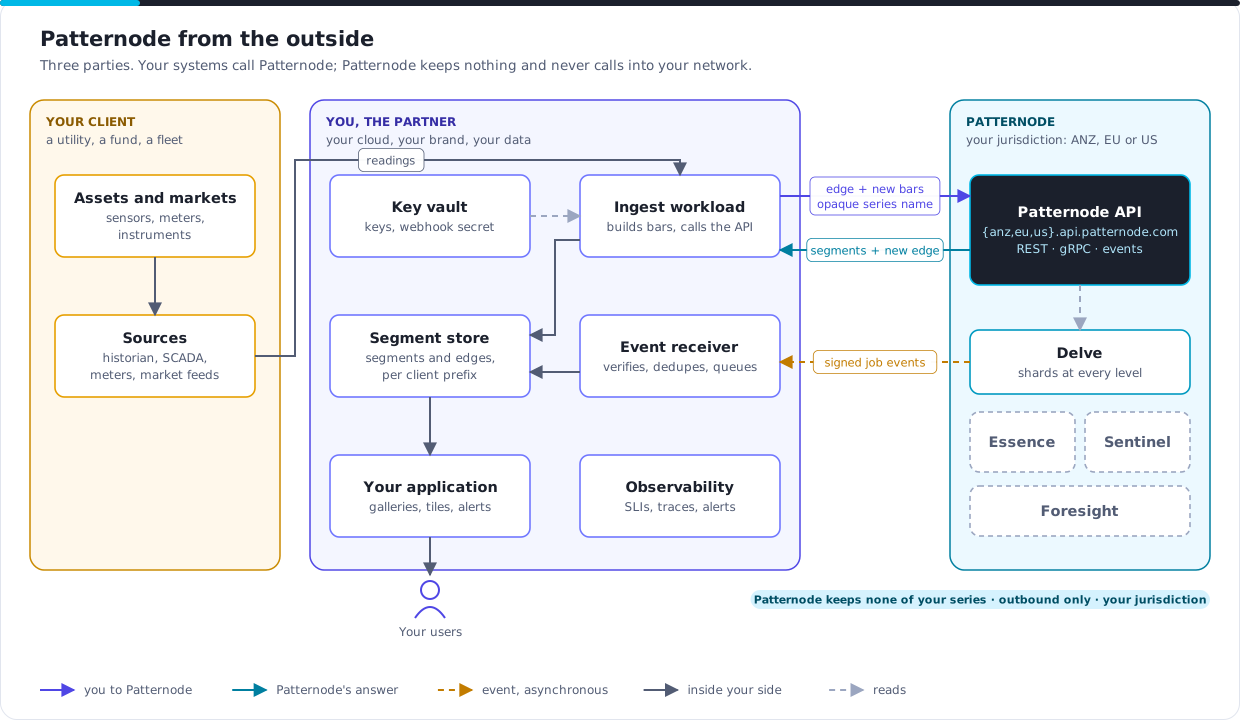
Three parties:
| Party | Owns | Runs |
|---|---|---|
| Your client (a utility, a fund, a fleet operator) | Assets, readings, the relationship with you | Historians, SCADA, meters, market feeds |
| You, the partner | Your product, your brand, your data and your keys | An ingest workload, a segment store, an event receiver, your application |
| Patternode | The service | The Patternode API: Delve today; Essence, Sentinel and Foresight on the same foundation |
The architecture at a glance
| Concern | Answer |
|---|---|
| Integration style | API-first. Your backend calls Patternode; Patternode answers and sends events. No agent, connector or software of Patternode's runs in your environment |
| Direction | Outbound only from your side. Patternode never connects into your network; events reach an endpoint or event bus you choose |
| Interfaces | REST and JSON (OpenAPI 3.1) on every plan; gRPC on Mission Critical and Dedicated; webhooks and event-bus delivery (AsyncAPI 3.1); bulk files (CSV, JSON Lines, Parquet, Arrow) read from and written to your storage |
| Interaction | Synchronous for a finished series and for each extension of a forming series; asynchronous for backfill jobs and events |
| What crosses | Bars (time, open, high, low, close) under a series name you make up. Segments come back. Nothing else |
| Where data lives | Everything about your series is in your store: readings, segments, and for a forming series its edge. Patternode keeps none of it, not even between calls |
| Residency | You choose a jurisdiction (Australia and New Zealand, the EU or the US); data never leaves it |
| Identity | API keys on every plan; OAuth 2.0 client credentials with signed assertions, mutual TLS and workload identity on Mission Critical and Dedicated |
| Resilience | Up to 99.99% availability, active-active across two regions, 60-second regional failover, nothing acknowledged lost (Plans) |
| Semantics | Stateless: the same edge and bars always give the same answer, so retries are exactly-once in effect; at-least-once events; deterministic results per pinned profile version |
| Change | One functional contract for every plan, product and industry; versioned in the path; changes announced in the changelog |
One API, every product
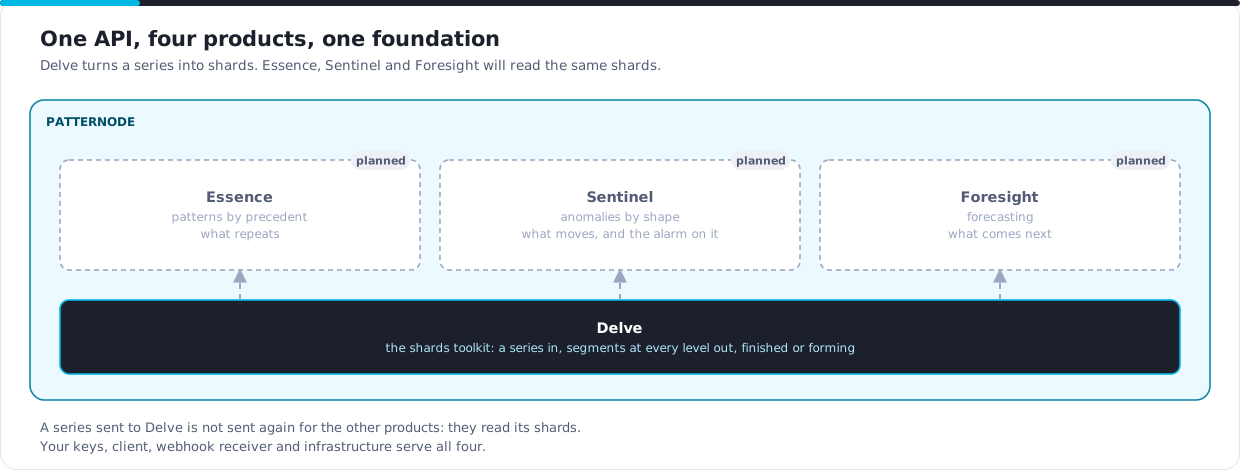
Integrate once. A series sent to Delve is not sent again for the products that run on it, and your keys, client, event receiver and infrastructure serve all of them.
Architecture principles
- Your data stays yours. Patternode receives the minimum (bars under opaque names) and keeps nothing, not even a forming series between calls. You store the results and the edge.
- Outbound only. Nothing from Patternode connects into your network, which keeps it outside operational technology perimeters and simplifies your security review.
- Contract first. The OpenAPI, AsyncAPI and gRPC files are the contract; this site, the mock server and the examples follow them.
- One contract, many plans. Moving up a plan changes capacity and service levels, never your code.
- Safe to retry. The same edge and bars always give the same answer, so a retry, a restart or a failover never double-counts or loses a bar.
- Deterministic. The same bars with the same profile version give the same segments, always, so backtests, audits and live operation agree.
- Your jurisdiction. Your series are processed only in the jurisdiction you choose, and support access stays there.
- No lock-in. Segments and edges are already in your store, and the contract is published under Apache 2.0.
Read next
| You are | Read |
|---|---|
| An enterprise architect checking fit | Security and data, Deployment and resilience, the service contract |
| A solution architect designing the integration | Integration architecture, Your side, the reference architectures, Decisions you make |
| An engineer building it | Detailed flows, the Quickstart, the API reference |
| A project lead | The onboarding playbook |