Integration architecture
For solution architects. How your systems and Patternode's exchange data, and which style suits which need.
Four styles
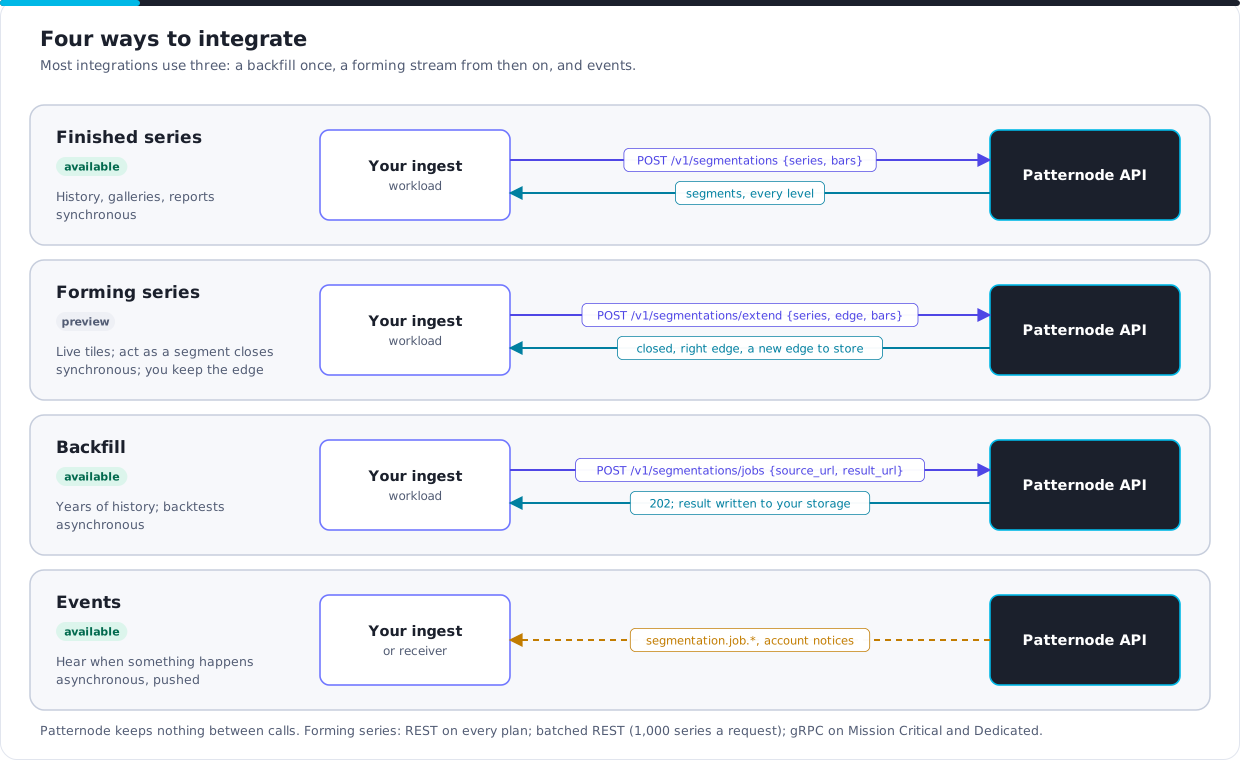
| Style | Interaction | Use for | Status |
|---|---|---|---|
| Finished series | Request and response, one call per series window | History, galleries, reports, daily redraws | Available |
| Forming series | Request and response: the stored edge plus new bars in, the new edge out | Live tiles; acting as a segment closes | Preview |
| Backfill | Asynchronous: a job reads your storage and writes the result back to it | Years of history, backtests, bodies over 5 MB | Available |
| Events | Pushed to you: webhook or event bus | Jobs finishing, account notices | Available (webhooks) |
A typical integration combines them over a series' life:
Interfaces and transports
Every transport carries the same operations with the same semantics; the faster ones are optimisations, not different APIs.
| Interface | Contract | Plans | Typical use |
|---|---|---|---|
| REST, JSON over HTTPS | specs/openapi.yaml | All | Everything; the reference |
| Batched REST extensions | specs/openapi.yaml, POST /v1/segmentations/extend/batch | All | Up to 1,000 series in one request, each with its edge |
| gRPC bidirectional stream | specs/proto/patternode/delve/v1/delve.proto | Mission Critical, Dedicated | Sustained high rates, low tail latency |
| Webhooks, signed to Standard Webhooks | specs/asyncapi.yaml, channel webhook | Production and above | Job results, account notices |
| Event bus (Amazon EventBridge, Kafka), CloudEvents 1.0 | specs/asyncapi.yaml | Mission Critical, Dedicated | Events into your own bus, without running a receiver |
| Bulk files (CSV, JSON Lines, Parquet, Arrow IPC) | POST /v1/segmentations/jobs, links to your storage | All | Backfills and backtests |
Synchronous and asynchronous
| Synchronous | Asynchronous | |
|---|---|---|
| Calls | Finished series; each extension of a forming series | Jobs; every event |
| Your side needs | A client that resends unchanged with backoff, and a store that keeps segments and edge in one write | A receiver or consumer that verifies, deduplicates and answers fast |
| Ordering | Per series, by the edge's last close time | None; deduplicate and order by your own records |
| Delivery | Exactly-once effect: same edge and bars, same answer | At least once; deduplicate by event id |
Contract governance
| Topic | Rule |
|---|---|
| Source of truth | The files in specs/. Pages, the mock and the examples follow them |
| Versioning | In the path (/v1/). No breaking change to an available operation within a version; a new version runs beside the old for at least 12 months |
| Status | Each operation and event carries x-status: available, preview (may change with 30 days' notice) or planned (specified, not yet served) |
| Extensions | An industry-only addition is an OpenAPI Overlay in specs/overlays/, never a change to the core |
| Compatibility | Clients must ignore unknown fields, enum values, event types and error codes |
| Determinism | Results are fixed per profile version; versions are served for at least 24 months |
Next: Your side, for what you build to use these interfaces.